LoL Duo Restrictions Explained: Who Can You Queue With?
8 min read
Can't queue ranked with your friend? Here's how League of Legends duo restrictions work across Solo/Duo, Flex and casual modes, and how to find a duo you can actually queue with.
League of Legends doesn't let just anyone duo in ranked. If the client keeps throwing an error when you invite a friend, it's almost always a rank gap. This guide covers how LoL duo restrictions work in Solo/Duo and Flex, which modes have no limits, why Riot keeps these rules, and how to find a partner who's actually in your allowed range.
The Short Version
- Ranked Solo/Duo has the strictest rules. You can only queue with one other player, and that player has to be close to your rank.
- Ranked Flex is far more relaxed about rank gaps and lets you queue with a bigger group.
- Normals, Swiftplay, ARAM and rotating modes have no rank restrictions at all. Anyone on your friends list can join.
- Higher tiers get tighter. The closer you are to the top of the ladder, the smaller the gap Riot allows, and at the very top duo can be limited or switched off depending on the region.
Riot tweaks the exact brackets between seasons and sometimes by region, so treat the in-client message as the final word. If the game says you can't queue together, no workaround will change that.
How Solo/Duo Rank Restrictions Work
In Solo/Duo, the rule is basically "stay close." The allowed gap depends on where you sit on the ladder.
Lower and mid tiers
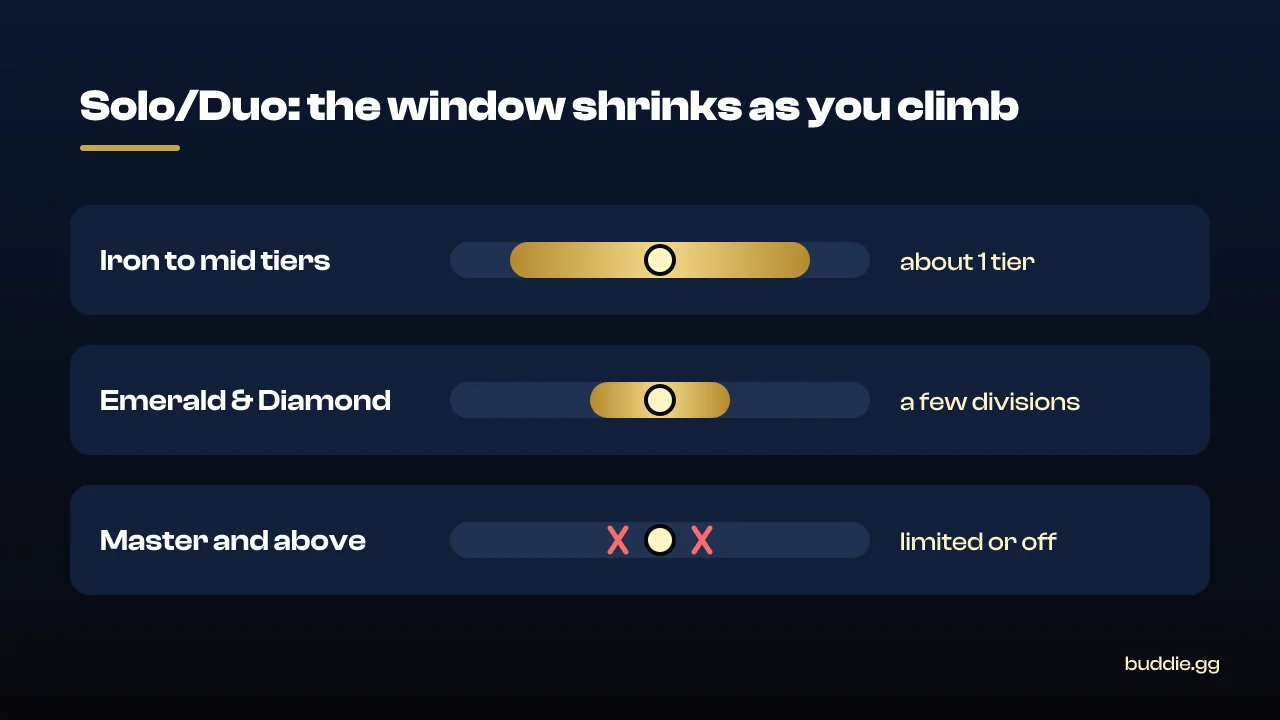
From Iron up through the mid ranks, the general rule is that you can duo with someone within about one tier of you. A Silver player can usually queue with Bronze, Silver or Gold. A Gold player can usually go one tier down or one tier up. Your exact division matters less here than your tier.
High tiers (Emerald and Diamond)
As you climb, the window shrinks. Around Emerald and Diamond, Riot starts checking divisions instead of whole tiers. A Diamond player, for example, is typically only allowed to duo with players a couple of divisions away. A Diamond I and an Emerald II player who could have queued together a few months ago may suddenly be blocked.
Apex tiers (Master and above)
Master, Grandmaster and Challenger are where duo is most limited. In several regions Riot has restricted or fully disabled duo queue at these ranks to protect match quality and stop boosting. If you're climbing into Master with a duo partner, expect that you may have to finish the climb solo.
Unranked and placement players
If you haven't finished placements yet, the client still checks your hidden or previous rank. Don't assume a fresh-season account is free to duo with anyone. The restriction is based on what the system thinks your skill is, not just on the badge you're showing.
Ranked Requirements Before Duo Even Matters
Some "duo restriction" errors are really ranked access errors. Before you can play ranked at all, your account needs to:
- Be summoner level 30.
- Own at least 20 champions (Riot has used this number for years for draft pick).
- Have no active ranked restriction from penalties.
That last one catches people out. If either player has a ranked queue ban, leaver penalty or a low-priority timer, you won't be able to queue together. Low honor level doesn't block duo by itself, but it can affect ranked rewards, which is another reason to keep your account clean.
Ranked Flex: The Looser Option
If your friend is too far above or below you for Solo/Duo, Flex is the usual answer. It has a separate rank and much wider tolerance for skill gaps, so mixed-rank friend groups can play ranked together.
A few things to know about Flex:
- You can queue solo, as a duo, as a trio or as a full five-stack. Groups of four aren't allowed, since that would leave one random player on a team of friends.
- Rank gaps are much more forgiving than Solo/Duo, though very large gaps at the top end can still be blocked.
- Matchmaking weighs your whole group, so a big gap often means a tougher lobby for the lower-ranked player.
Flex is great for playing with friends. It's less useful if you specifically want to raise your Solo/Duo rank, since the two ladders are separate.
Casual Modes With No Duo Restrictions
When you just want to play together, skip ranked entirely:
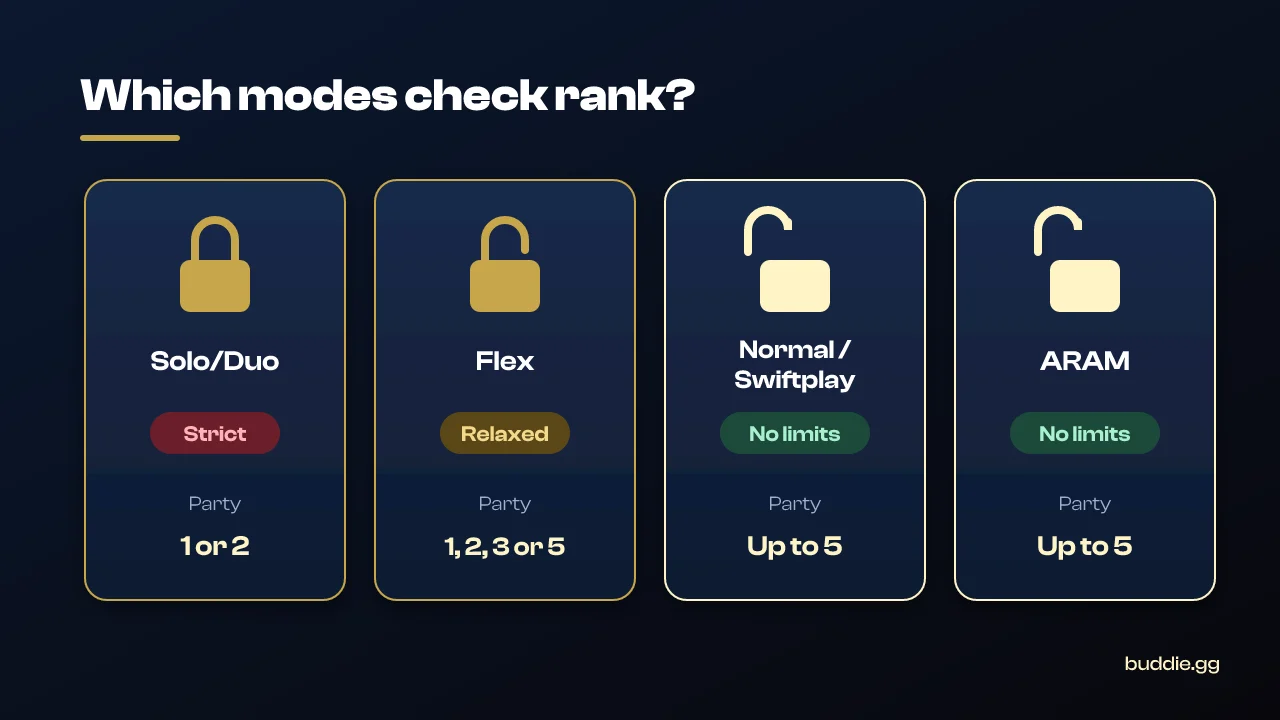
| Mode | Rank restriction? | Party size | |---|---|---| | Ranked Solo/Duo | Yes, strict | 1 or 2 | | Ranked Flex | Yes, relaxed | 1, 2, 3 or 5 | | Normal Draft / Swiftplay | No | Up to 5 | | ARAM | No | Up to 5 | | Arena and rotating modes | No | Depends on mode |
These are perfect for helping a newer friend learn, testing a bot lane combo, or warming up before a ranked block. Matchmaking still adjusts to your group's MMR, so a Diamond player duoing with a brand-new friend will pull the lobby up a bit.
Why Riot Has Duo Restrictions
The rules annoy people, but there are real reasons for them:
- Fair games. If a high-elo player could carry a much lower-ranked friend, the enemy team would face a smurf-level opponent every game. The rank gap rule keeps lobbies balanced.
- Stopping boosting. Duo boosting (a high-rank player duoing a low-rank account up the ladder) is against Riot's rules. Tight brackets make it much harder.
- Rank meaning something. If your rank came mostly from who you duoed with, it wouldn't reflect your own skill. Restrictions keep the ladder honest.
There's also a common worry that duoing hurts your MMR. That's a separate topic, but the short answer is that duo is a normal, supported way to play ranked as long as you stay within the rules.
What To Do When You Can't Duo Your Friend
If the gap is too wide, you've got a few options:
- Play Flex together. Same ranked feel, much looser rules.
- Play normals or Swiftplay. Zero rank checks, full games, real practice.
- Let the lower-ranked player climb first. Sometimes one good week closes the gap.
- Find a Solo/Duo partner in your own range. This is the move if your goal is climbing your Solo/Duo rank.
For option four, a partner close to your rank is actually ideal. You get matched fairly, you both learn at a similar pace, and nobody feels carried.
Finding a Duo Who Fits Your Rank
The hardest part of duo restrictions is finding someone who's both in your bracket and good to play with. Random ranked teammates disappear after one loss, and friends are rarely the exact rank you need.
That's where buddie can help. On the League of Legends LFG page you can filter buddies by rank and role, so you only see people who can actually queue with you and who fill the role you need. Want a support for your ADC or a jungler who'll path to your lane? Filter for it.
A few practical tips when you pick someone:
- Check the rank first. Make sure the buddie sits inside your allowed Solo/Duo window, or plan to play Flex or normals together.
- Listen to the voice intro. Many buddies have one on their card, and it's a quick way to see if the vibe matches yours.
- Message before you order. You can ask about champion pools, playstyle or whether the buddie prefers ranked grinding or a chill game.
- Use the order room. Every order opens a private room with chat, voice call and screen sharing, which is handy for reviewing a replay or planning a draft.
Each buddie sets their own price, either per game or per hour, so you can choose what fits. And if you play other Riot games too, the same filters work across all games on buddie, including Teamfight Tactics if you want a Double Up partner.
If you're on the other side of this, a high-ranked player who knows how to duo well, you can apply on the Become a buddie page. You need to be 18 or older, and every application is reviewed before approval. Just remember that Riot's rank restrictions still apply to you in ranked, so Flex and normals are often the easiest way to play with customers outside your bracket.
FAQ
What rank gap is allowed for duo in League of Legends?
In Ranked Solo/Duo, lower and mid tiers can generally duo within about one tier of each other. From Emerald and Diamond upward, the window narrows to a few divisions, and Master+ duo is heavily limited or disabled in some regions. Riot adjusts these brackets over time, so the client's error message is always the most accurate check.
Can I duo with a friend who is much higher rank than me?
Not in Solo/Duo if the gap is too big. You can still play together in Ranked Flex, which is much more lenient, or in normals, Swiftplay and ARAM, which have no rank checks at all.
Why can't I queue ranked with my friend even though we're the same rank?
Usually one of you has a ranked restriction, like a leaver penalty, queue ban or low-priority timer. It can also be an unfinished requirement such as summoner level 30 or owning 20 champions. Placement accounts are judged on hidden MMR too, so the displayed rank isn't always what the system checks.
Can you queue as four in Flex?
No. Flex allows solo, duo, trio or a full five-stack, but not a group of four. If you have four friends, either add a fifth or split into a duo and a trio.
Does buddie handle Riot's duo rules for me?
No, Riot's in-game rules always apply. What buddie does is let you filter League buddies by rank and role, so it's easier to find someone inside your allowed range. If you have a problem with an order, the Help center explains how support tickets work.